Perge is a separate archaeological destination in Aksu, not another name for Aspendos or the ancient centre of Side. From an Alanya accommodation, the useful question is whether you want to give this ancient city a substantial part of the day, with the outward and return journeys planned around it. One current detail matters before you choose: the official visitor information lists the site as open but its ancient theatre as temporarily closed for restoration. Plan for the visit that is actually offered, not the circuit shown in an older holiday photograph.
Choose Perge for the city remains, not a theatre promise
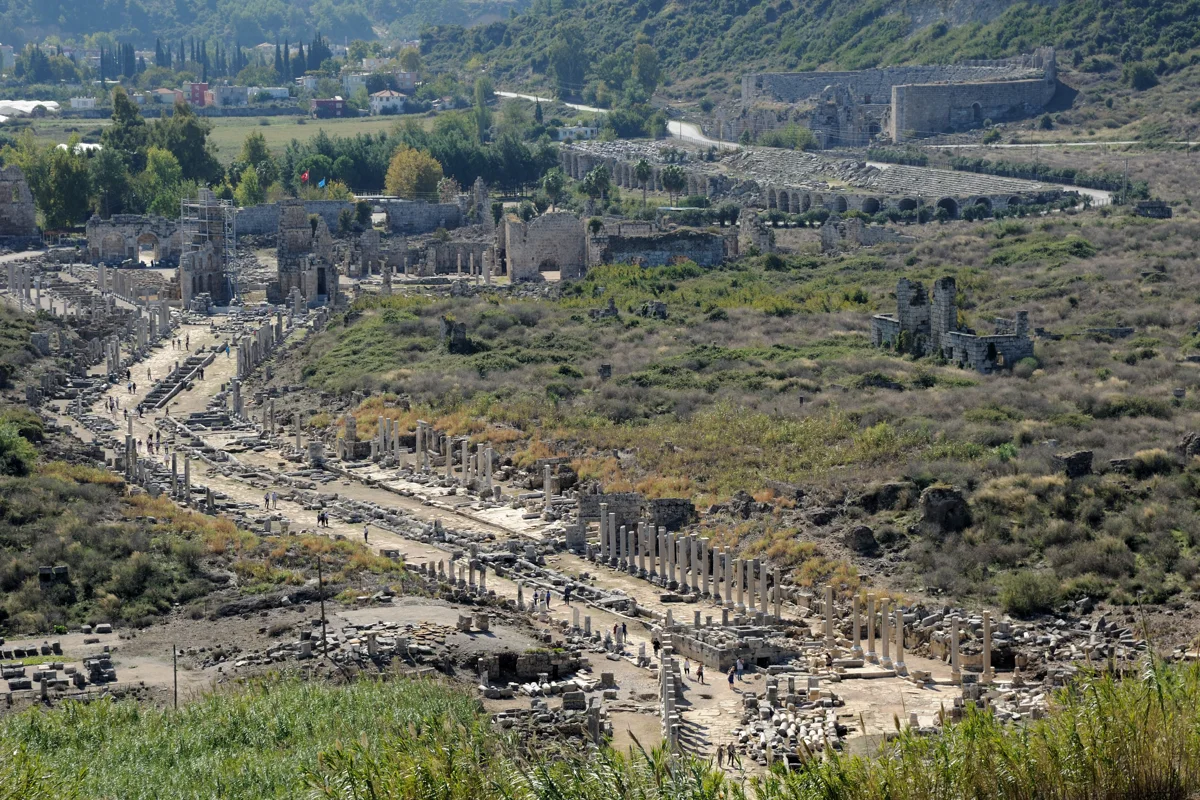
The Ministry's Perge listing locates the site in Aksu, Antalya, and describes an ancient urban landscape including gates, an agora, baths, colonnaded streets and water structures. These features make the place interesting as a city, rather than merely a backdrop for one monument. The visitor route on the day determines which parts you can enter.
If your main aim is to see a particular theatre, reconsider the destination before committing the drive. Our Aspendos guide covers a different site and a different visit. Do not treat a combined excursion advertisement as evidence that both theatres are accessible. Choosing one archaeological focus that matches your interests is more useful than arriving with expectations borrowed from another ancient city.
Check the theatre closure independently of opening hours
The official closure notice, checked on 11 November 2026, says Perge's ancient theatre remains temporarily closed until the required restoration is completed. It is not a notice closing the entire archaeological site. Conversely, the site's daily opening schedule is not evidence that the theatre has reopened.
Check for an updated notice before travelling, especially if the theatre is essential to your plans. Do not enter beyond barriers or interpret a visible restoration area as an invitation to look around. The practical choice is to enjoy the accessible city remains or select another outing. A rental car gives you a transport option; it cannot turn an unavailable component into part of your admission.
Use the current listing rather than the older brochure's timetable
At the same check, the Ministry listing gave opening at 08:00, closing at 17:00 and ticket-office closing at 16:30, with daily operation. The downloadable Ministry brochure shows a different seasonal timetable. Use current visitor notices and reconfirm your date rather than relying on the later closing time in the older PDF.
The last ticket time is a limit, not a useful target for a detailed visit. Decide how long you want to spend walking and understanding the remains, then work backwards through admission, parking and the drive. If a late start from Alanya leaves only a brief interval inside, move the visit to another day. Reaching the gate before it closes is not the same as having an enjoyable archaeological outing.
Start the route at your actual accommodation
Alanya covers many possible holiday bases. Put your property's vehicle exit into navigation, then use the confirmed Perge visitor entrance as the destination. A journey starting farther along the coast is not identical to one from a central hotel. Check the complete route and the return rather than copying a fixed time from a search snippet or another traveller's itinerary.
Include anything that happens before the drive, particularly collecting the rental and learning its controls. If a hotel handover is requested, confirm that arrangement with the supplier rather than assuming it is included. The same applies to fuel and equipment. A day that begins with an unconfirmed collection time should not also depend on a tightly timed guided visit at a distant attraction.
Make it a dedicated day or an explicitly planned onward stop
For a return outing, keep the day's main purpose clear: Perge and a manageable meal or rest break. Adding Antalya, Side and Aspendos simply because they appear in regional sightseeing lists can leave little time at any one place. Compare the complete journey with your group's enthusiasm for archaeological walking before choosing the longer version.
An onward journey towards another accommodation is a different plan. It introduces luggage, a new check-in and possibly a different vehicle return location. Confirm those arrangements before treating Perge as a convenient stop between bases. A one-way route on a map does not establish that your rental may be returned elsewhere, or that belongings can safely remain in the car throughout the visit. Keep those practical decisions separate from the attraction choice.
Choose a rental for comfort across the whole journey
Consider who will drive, passenger space and the amount of luggage that actually travels with you. A comfortable familiar vehicle is more useful than choosing a category because it looks suitable for ruins in a photograph. Confirm transmission and any essential child restraint or mobility-equipment fit. Do not infer a guaranteed model or feature solely from a category image.
Use the Alanya rental catalogue with your actual dates and collection point. Vrenty Car provides affiliate information, Localrent handles the booking and the selected company supplies the vehicle. This destination guide does not confirm a rental desk at Perge or an included guided tour. Compare the full rental total and the handover arrangements, not just the first daily price displayed beside a car.
Keep the vehicle on roads permitted by the agreement
Localrent's Turkey conditions restrict rental use to paved public roads. Check any uncertain final approach with the supplier and follow the current visitor directions. An SUV does not create permission to use a track, a closed service entrance or a route through the archaeological area. Vehicle capability and contractual permission are different questions.
If navigation proposes a doubtful shortcut, review it while safely stopped rather than following it to recover lost time. Prefer a clearly suitable signed approach and ask for clarification when necessary. Do not assume that other vehicles visible beyond a barrier are ordinary visitors; they may have a different purpose or authorisation. If the permitted visitor approach cannot be established, resolve that issue before committing the outing.
Separate arrival, parking and admission
Save the official site name and address before departure, but check the actual entrance arrangement when you arrive. Archaeological sites can have multiple visible structures and map markers; a pin for a theatre is not necessarily the entrance for today's open route. Follow current signs and staff directions rather than aiming for whichever monument is easiest to recognise from the road.
This guide does not guarantee a parking price, capacity or particular space. Establish where the vehicle may remain and how your group will continue on foot. Organise tickets, water and essential belongings before leaving the car. A clear arrival routine avoids repeated trips across a vehicle movement area and lets the person driving finish that task before also becoming the group's navigator inside the site.
Decide what admission or a pass actually covers
Check the current admission product and any eligibility requirements directly with the operator. Do not assume a pass intended for one visitor category applies to everyone in your party, or that a general museum card includes every experience. An admission price is separate from a guide, transport, refreshments and any additional service you arrange.
If you already hold a regional pass, verify the exact product name, validity period and whether your intended visit is included before counting it as prepaid. Keep proof available offline. For a paid guided visit, confirm the meeting point, language and start time as well as admission. A guide reservation and permission to enter a restricted area are not the same thing; the current closure still governs what can be visited.
Read the city as a connected place
Rather than racing between recognisable photographs, look for how the streets, public buildings and water features relate to one another. A gate, a street and a gathering space tell a different story when considered as parts of the same settlement. Use the site's interpretation and current visitor map to orient yourself, keeping historical reconstruction separate from what remains visible today.
Choose a few themes that interest your group. One person might focus on urban organisation, another on how water served public spaces, and another on architectural details. Discussing those observations can make a shorter visit more meaningful than trying to identify every fragment. Stay within the designated route and do not climb remains or cross restricted sections to improve a photograph. An archival image illustrates the site, not today's access boundaries.
Assess the walking separately from the drive
Being able to reach Perge by car does not establish that every visitor route is suitable for every passenger. Ask about the current surfaces, steps, walking distances and any shorter option when mobility needs matter. Describe the actual requirement rather than asking only whether the attraction is accessible. A level-looking part of one photograph cannot describe the whole circuit.
For a mixed group, agree a pace and a meeting arrangement before separating. Nobody needs to follow the longest possible route to make the drive worthwhile. With children, allow time for questions and rest instead of treating the walk as a timed challenge. If a planned section proves unsuitable, choose a shorter route or end the visit; the rental's availability should support the group rather than dictate how long they remain outside.
Prepare for time outside an air-conditioned car
Check the weather for the intended visit and choose footwear and clothing for walking, not only for the road journey. Carry drinking water and the personal items your group will need. Confirm any essential facilities in advance instead of relying on an unverified café, locker or shaded waiting area being available exactly where you want it.
Keep the day bag manageable and leave unnecessary holiday luggage at your accommodation where possible. A charged phone is useful for navigation and booking details, but should not occupy attention while negotiating an uneven section. Stop to take photographs or read a screen. Allow the driver a break before the return rather than moving straight from the last walking section into a pressured road journey.
Compare with a closer archaeological outing when appropriate
The Syedra guide offers a separate archaeological option nearer the Alanya area, with its own sloping visitor landscape and access questions. It is not a substitute description of Perge. Compare the experiences and the total road time rather than deciding that more driving necessarily means a better day.
For a short holiday, selecting one site is a reasonable choice. For a longer stay, separate visits can give each place more attention. The Side road-trip guide describes another distinct destination with a different town-and-archaeology setting. Keep these as alternatives first. Combining them should follow a checked itinerary and realistic opening windows, not a desire to complete every ancient name in the region.
Protect the return and any rental handback
Choose a latest comfortable departure before you begin optional additions. If the main visit takes longer, remove the extra stop rather than compressing the road margin. Check the return destination while parked: it may be your original accommodation, another property or the supplier's agreed handback point. A previous airport search left in navigation can otherwise send the driver towards the wrong finish.
Localrent requires advance coordination for a rental extension. Do not assume a later museum departure automatically allows a later vehicle return. Include any required fuel stop, unloading and inspection in the schedule when the hire ends that evening. Keep the driver comfortable enough to make ordinary decisions without pressure. A successful day is the visit you wanted and a straightforward return, not the greatest number of places reached.
Use a final decision check before setting out
Recheck the current site notice, especially the theatre status, and confirm that the accessible parts still match your reasons for going. Review the actual road journey, admission arrangements and any essential access requirement. Keep the supplier contact and return instructions available without relying on a fresh download. If an unresolved point is central to the day, obtain confirmation before leaving rather than hoping the entrance staff can solve the whole itinerary.
If conditions or timing make the outing unsuitable, choose a simpler alternative or another day within your booking conditions. That is not wasted rental time: the car is a tool for reaching a worthwhile visit, not an obligation to maintain an ambitious route. Perge deserves enough attention to understand the ancient city, and your passengers deserve a plan that leaves energy for the journey back.
Questions & answers
Is all of Perge closed because of restoration?
The checked notice concerns the ancient theatre, while the main site listing continues to show daily opening. Recheck current notices for your date and follow the open visitor route.
Can I use an older brochure's closing time?
Use the current official listing and confirm essential timing. The downloadable brochure and current listing differ; do not build a late arrival around the older, later hour.
Should I combine Perge, Aspendos and Side?
Only after checking complete journeys, separate admissions and the time wanted at each site. A dedicated Perge day is a simpler starting point than an automatic multi-site circuit.